by Marta Djordjevic
photo: Stefan Zdraveski
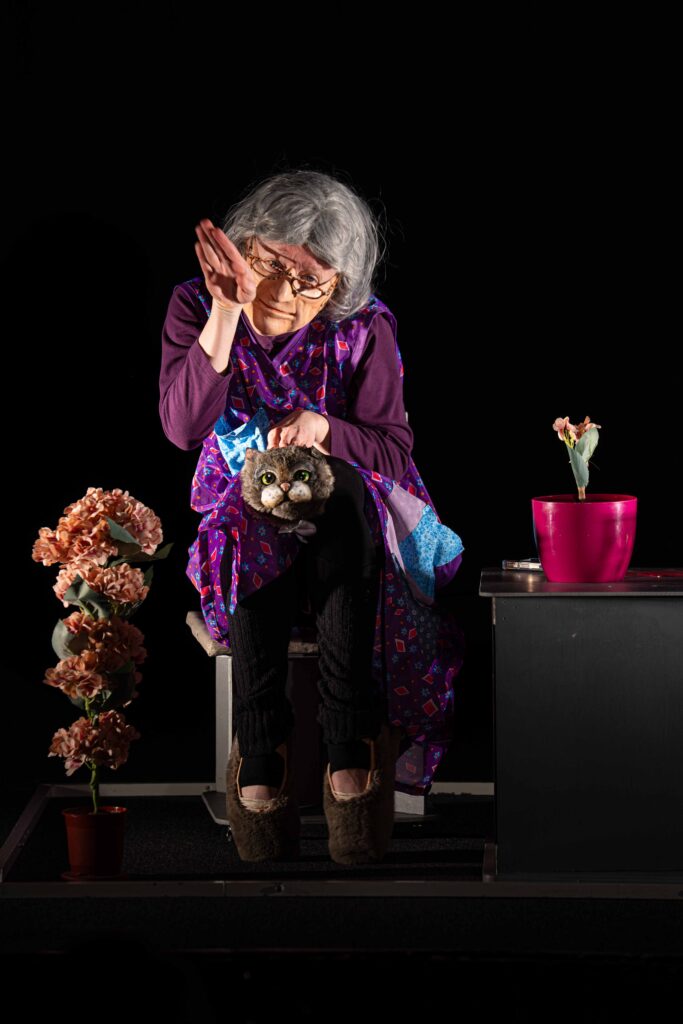
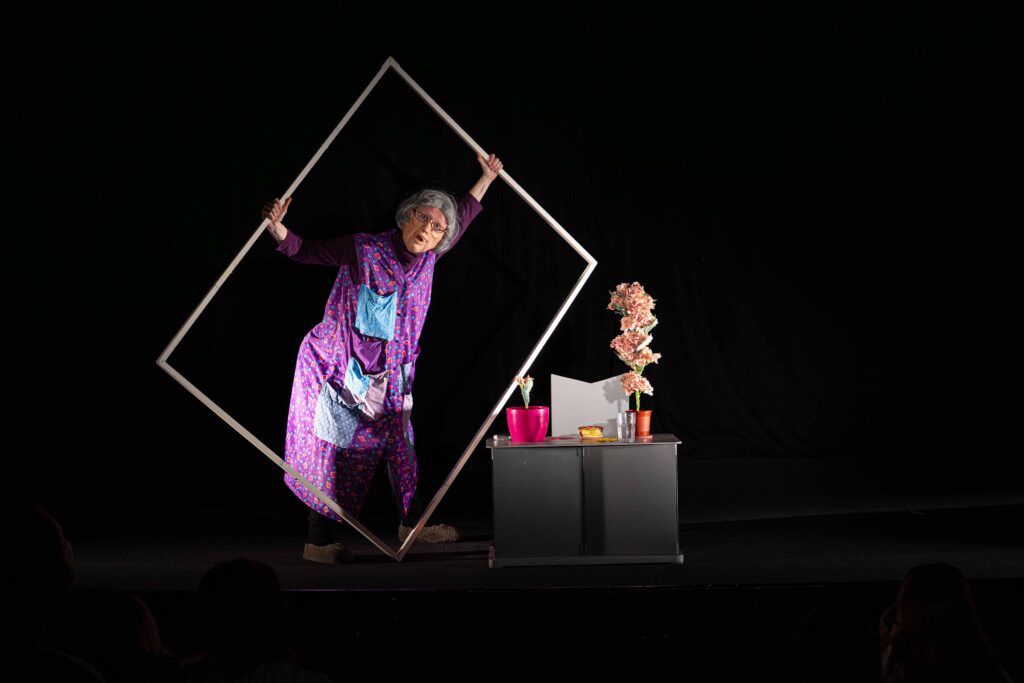
The final evening of the 29th Art Trema Fest opened with the performance 2 sqm, a piece that explores aging, memory, and loneliness through a form that relies almost entirely on movement, gesture, and visual theatre, without a conventional dramatic text. Directed by Tamás Somogyi, the stage—or rather a confined two-by-two-meter space—features an elderly woman, performed by Rita Gobi, enclosed within a minimalist world composed of a table, a wheeled chair, flower pots, empty glasses, and a few carefully placed props.
The performance establishes an intimate environment in which the woman attempts to expand her own world through a series of repetitive actions: watering, observing, reacting to subtle changes in the space. The artificial flowers that “grow” under her water spray become the central metaphor of the piece—an illusion of life that can be activated but not sustained. In this context, the presence of a modern smartphone (an iPhone Pro Max) creates a somewhat unclear contrast—whether it disrupts the illusion of this intimate world remains an open question that the performance does not fully resolve.
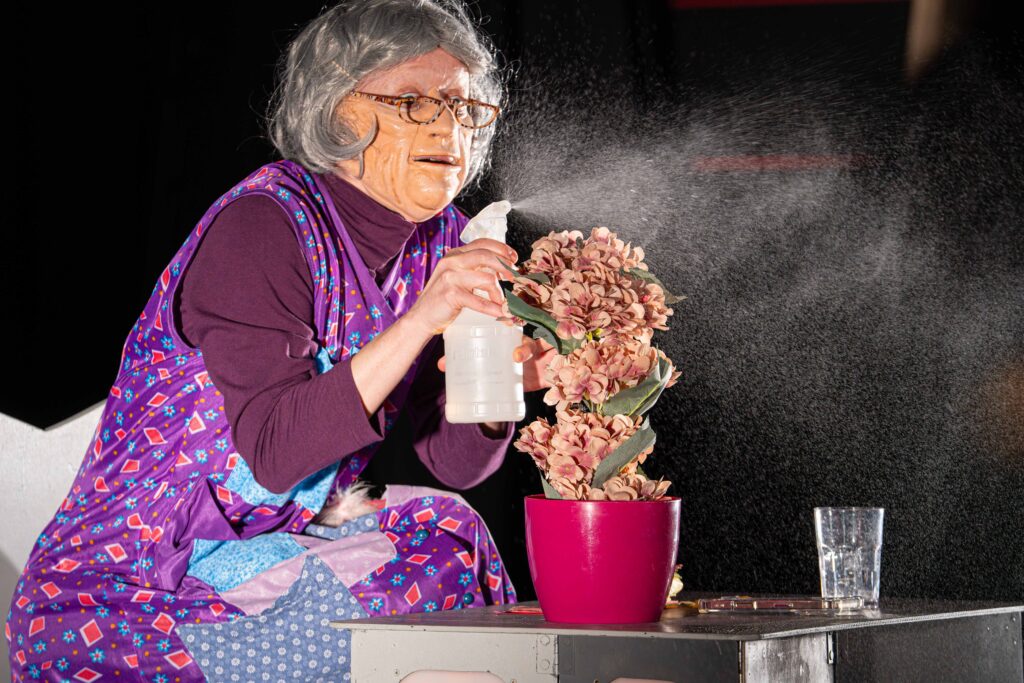
Through movement and elements of puppetry, the performance aims to prompt reflection on the relationship between youth and old age, body and memory, and the possibility for the “younger self” and the “older self” to meet within a single stage space. Wearing a realistic yet slightly grotesque mask, the performer engages in actions characteristic of elderly women, evoking familiar gestures associated with our grandmothers. In this sense, the performance has a clear and emotionally strong theme, yet its stage expression does not always articulate this idea with equal clarity.
In terms of performance, Rita Gobi builds a character that is both fragile and playful, particularly in moments when movement becomes the only form of communication with the audience. However, certain directorial choices raise questions: the transition between the realistic elderly woman and the figure of a “former ballerina” is not clearly established dramaturgically, so what could have been a powerful emotional climax unfolds more as a series of suggestions than as a precisely shaped stage event.
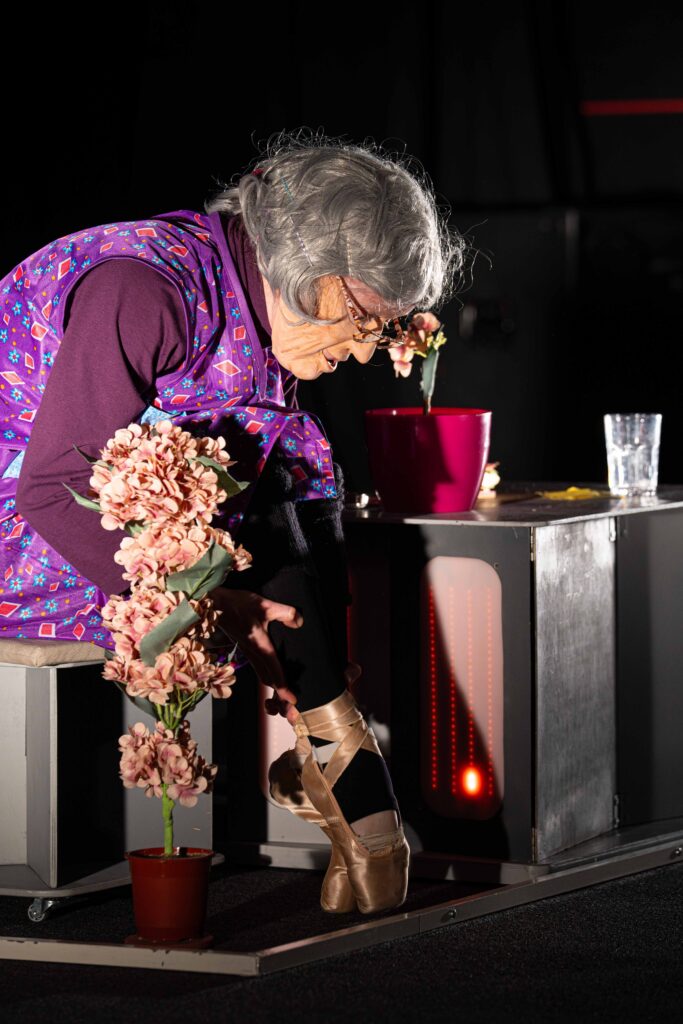
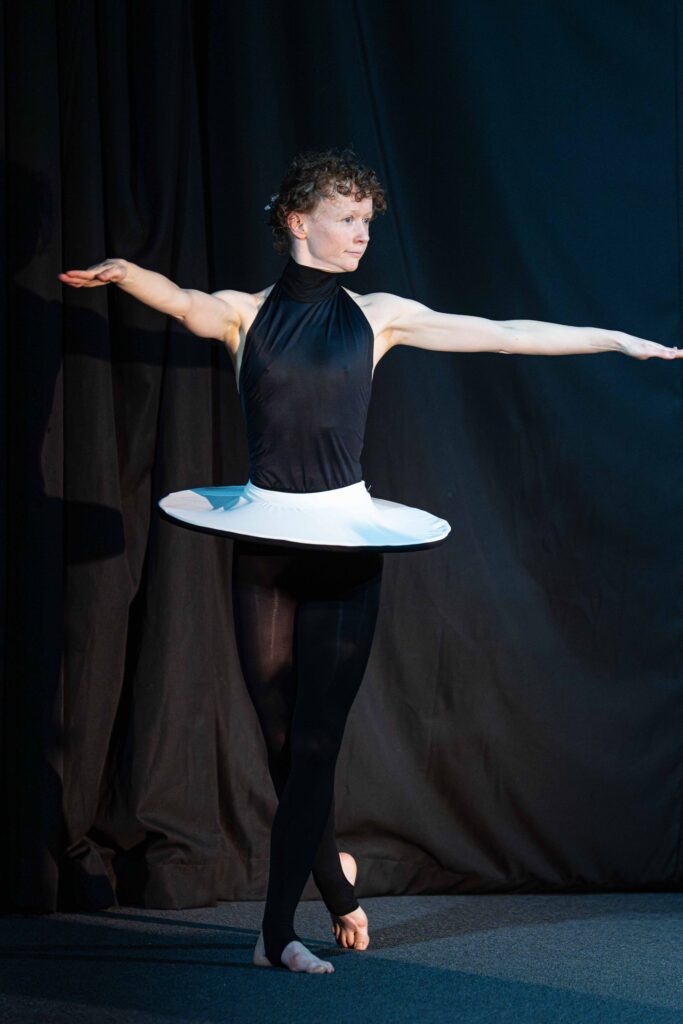
The ending further complicates the stage logic: the performer’s exit from the confined space, the removal of the elderly costume offstage, and the subsequent ballet sequence feel like solutions that are not fully integrated into the previously established stage world. Instead of a clear transformation or a closing of the circle on stage, the performance leaves an impression of interruption and incompleteness, which carries over to the audience’s experience. As a result, it feels as though the performance has two endings—something that could have been avoided in many ways, each likely more compelling.
One of the more striking motifs is the elderly woman’s relationship with “another being,” namely a cat, which briefly opens a space for tenderness and a need for connection. However, these moments remain underdeveloped, as if the performance does not fully pursue the relationships it initiates.
Although the piece carries strong thematic potential and moments of genuine emotional vulnerability, there remains a sense that the relationship between idea and its stage realization is not consistently balanced. For this reason, what could have been a moving and layered story about aging remains at the level of an intriguing, visually appealing, yet ultimately fragmented reflection on time, the body, and memory.
2 sqm
Directed by: Tamás Somogyi
Composer: Bánk Sáry
Costume and set design: Erik Grosschmid
Light design: Pavla Beranova(CZ)
Dancer and choreographer: Rita Góbi
Partner: Műhely Foundation and Trafó House of Contemporary Arts
The “Criticism” Programme is an initiative by Spam Studios, developed in partnership with Art Trema Fest as part of its 29th edition, and carried out with the financial support of the “Culture for Democracy” programme of the Swiss Embassy and the Hartefakt Fund in Serbia.